Italiano
Italiano
English
English  


   Many years of study and research into the Neapolitan presepe and their sculptors had made me think, at least for a time, that finding a truly unique and special work of art would be improbable: the composition presented here is proof that it is still possible to "come across" such objects.
  The physical dimensions of this small elliptical rock (h. 58x45x31 cm) populated by 58 animals - no higher than 2.5 cm - and 52 tiny figures - between 7 and 8 cm high - all made of polychrome terracotta, coated with egg tempera to protect the colours from changing with time, could lead one to imagine that it is a model for a second much larger composition, but the extreme perfection of form and the absence of the Tavern - generally an essential component of presepe from the seventeenth and eighteenth centuries - indicate the highly devotional scope of this masterpiece.
   The high quality of the ornamentation is revealed in the gilded stones of the ruined temple and its parchment-covered pilasters painted as lapis lazuli, while the individuality of the main structure is shown by the many and varied mother of pearl shells that decorate the base. All this, enriched by some sixty branches of coral, underlines the symbolic and propitiatory value that the chromatism and the materials assign to this small presepe which most probably was conceived of, and made, to mark the birth of a first son and given to him at Christmas, as was the long-standing tradition.
   Every element appears to be coordinated with perfect three-dimensional harmony between the scenography, the figures and the animals: each subject is carefully modelled in a particular stance according to its action, with no repetitions or duplications.
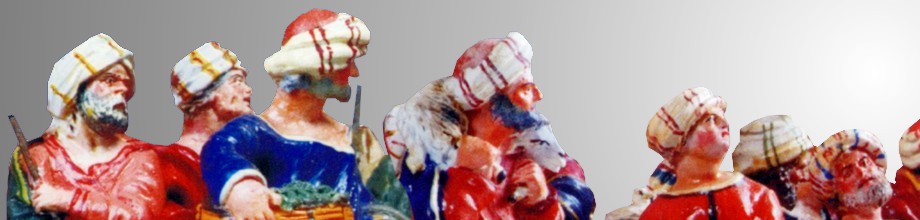
   The ruins that house the Nativity indicate the persistence of neo-classic taste, while the openings on the four sides imitate the design of a presepe with more settings; out on the slopes the Annunciation is made to the shepherds while Benino continues his hidden slumbers. Various groups indicate the way to the grotto: the “rich farmer” with his family and the peasants have set off from the old village; the wise men from the East in their bright clothes - which appear copied from the masques inspired by the visits of the Turkish ambassadors - go to the Temple bringing precious gifts to the poor Child who lies amongst the ancient stones.
   The bold and singular composition of the putti in the heavens surrounding the dove of the Holy Spirit has no equal - a unique example of complexity in miniature work, the circling movement of flight indicates the work of a master sculptor.
   But who was the author - or who were the authors - of this special presepe? On the basis of the types and the morphology of the subjects, we need to consider there being two artists, one for the animals and one for the figures.
   The first one can be identified as Tommaso Schettino, from the anatomic, plastic and chromatic characteristics of the animals which are similar to known works that he produced for the great presepes between the late eighteenth and the early nineteenth century. He also crafted small figurines, as well as being a modeller - from 1783 - at the Real Fabbrica Ferdinandea delle Porcellane (King Ferdinand’s Royal Porcelain Factory), where he created the casts for the animals that completed the groups of figures. Giovanni - Tommaso's brother - was already working as a modeller in King Ferdinand's establishment by 1783 (and until 1804), and several of his signed or initialled porcelain figures and groups are known. The elegance, the refinement of the formal synthesis and the flow of the carefully modelled and finished drapery in the figures of this presepe all point to the work of Giovanni Schettino. As an example, one possible comparison can be drawn with a group that depicts Africa, in the Capodimonte Museum in Naples and dated to about 1790, which can be ascribed to a collaboration of the two brothers. There is also a strong iconographic similarity with the biscuit figurines depicting "Vestiture del Regno" (Dress in the Kingdom) that were produced from 1785 (Museo degli Argenti in Florence).
   There is no certain evidence of what happened to the Schettino brothers after the closure of the porcelain factory in 1806, but it is probable that they lived on continuing their work as modellers of presepe figures for many years. A double "S" obtained from a chalk concretion, at the foot of one of the coral branches, testifies to their presence.
   The impression of a neo-classical background to be found among the bourgeois, rustic and Eastern characters of this presepe differs completely from the more celebrated manifestations of eighteenth century taste that persisted in presepes of the early decades of the nineteenth.


Gennaro Borrelli

Information taken from:
G. Borrelli, Il presepe napoletano, Roma 1970.
A. Caròla Perrotti, La porcellana della Real Fabbrica Ferdinandea (1771-1806), Napoli 1978.


Home   |    Creators   |    Expertise   |    Composition   |    Contacts   |    Figures   |     Animals   |    Putti   |     Download